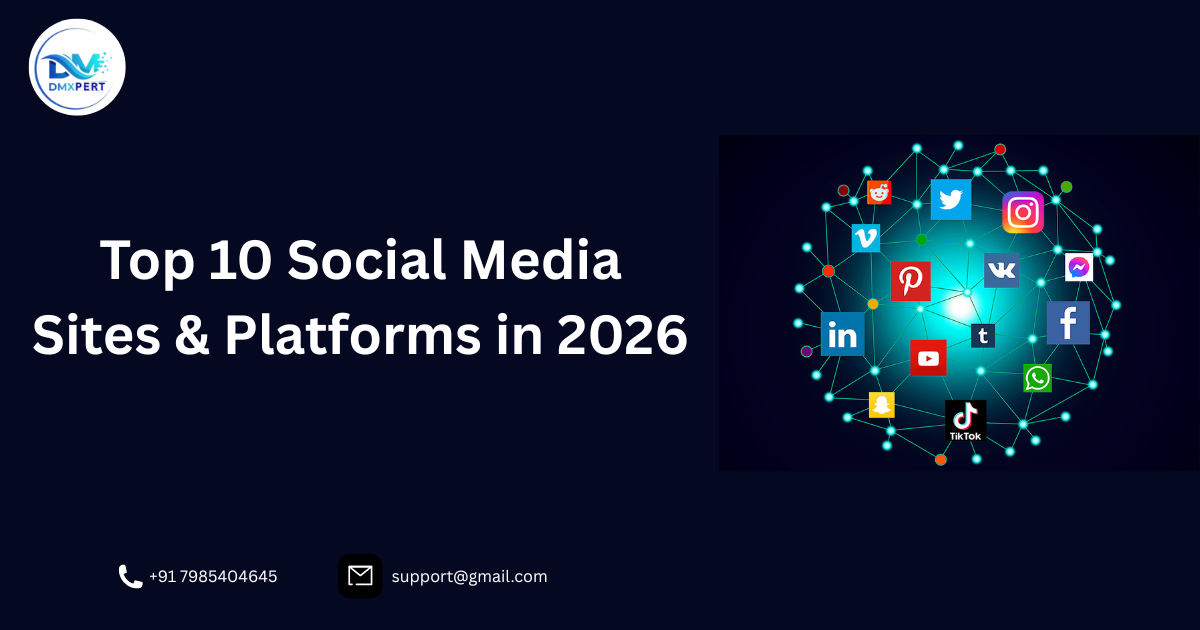
Top 10 social media sites and platforms in 2026 illustrated with popular social media app icons like Facebook, Instagram, YouTube, TikTok, LinkedIn, and WhatsApp

Top 10 Social Media Platforms & Sites in 2026
Top 10 Social Media Platforms & Sites in 2026

Top 10 social media sites and platforms in 2026 illustrated with popular social media app icons like Facebook, Instagram, YouTube, TikTok, LinkedIn, and WhatsApp

Social media has become the backbone of modern digital communication. From personal conversations to global brand campaigns, social media platforms influence how people interact, consume content, and make purchasing decisions. Today, billions of users actively use social media apps to stay connected, informed, and entertained.

What started as simple social networking sites has now evolved into powerful media platforms capable of shaping opinions, driving economies, and building global communities. Whether you are a business owner, marketer, creator, or everyday user, understanding the top 10 social media sites & platforms is essential in 2026.

This guide explores the most popular social media apps, their growth, features, and real-world impact. It also helps you decide which social media channels matter most for your goals.

What Are Social Media Platforms?

Social media platforms are digital environments—often called social sites or social apps—where users create social media accounts to share content, interact with others, and build communities. These platforms combine social media with S (sharing, social interaction) and social media with T (technology, targeting, tools) to create scalable digital ecosystems.

Unlike traditional websites, social media sites encourage two-way communication. Users are no longer passive readers; they actively comment, react, share, and participate. This is why social media channels have become critical for personal branding, customer engagement, and digital marketing.

Global Overview of the Top Social Media Platforms in 2026

Before diving deep into each platform, let’s look at a data-driven comparison of the top 10 social media platforms based on Monthly Active Users (MAU), revenue, launch year, and headquarters.

Top 10 Social Media Platforms 

Rank Platform MAU* Revenue Launched Headquarters
1 Facebook 3.07 billion Not specified 2004 Menlo Park, CA
2 Instagram 3 billion Not specified 2010 Menlo Park, CA
3 YouTube 2.5 billion $10.47 billion 2005 San Bruno, California
4 TikTok 1.6 billion Unknown 2016 Culver City, CA
5 Snapchat 932 million $5.36 billion 2011 Los Angeles, CA
6 X (Twitter) 586 million Unknown 2003 Mountain View, CA
7 Pinterest 578 million $3.6 billion 2005 San Francisco, CA
8 LinkedIn <350 million $17.8 billion (FY 2025) 2006 San Francisco, CA
9 Threads 300 million* Unknown 2023 Menlo Park, CA
10 Reddit 201–245 million** $1.3 billion 2010 San Francisco, CA

*MAU = Monthly Active Users
**Estimated range

1. Facebook

Facebook remains the undisputed leader among social media sites, with more than 3 billion monthly active users. Launched in 2004, it reshaped how people connect online and laid the foundation for modern social media platforms.

Facebook allows users to create profiles, share updates, photos, videos, and join interest-based communities. Over the years, it has evolved from a simple networking site into a full-scale media platform with advertising, e-commerce, live streaming, and messaging capabilities.

For businesses, Facebook is one of the most valuable social media channels due to its advanced targeting options. Brands can reach specific demographics, interests, and behaviors, making it one of the top social media platforms for digital advertising.

2. Instagram

Instagram is one of the best social media apps for visual content and brand engagement. Since its launch in 2010, it has grown into a platform with nearly 3 billion monthly active users.

Instagram focuses on images, short videos, Stories, and Reels, making it ideal for storytelling and personal branding. Influencers, creators, and businesses rely heavily on Instagram to build loyal audiences.

Among all social media apps, Instagram stands out for its strong engagement rates. It is particularly popular among Millennials and Gen Z, making it one of the most popular social media apps for lifestyle, fashion, fitness, and travel brands.

3. YouTube

YouTube is not just a social media site—it is the world’s largest video-first media platform. With over 2.5 billion users, YouTube has transformed how people learn, watch, and entertain themselves.

Unlike short-form video apps, YouTube supports long-form content, making it ideal for tutorials, reviews, documentaries, and educational videos. It is also one of the few social media platforms where creators can build sustainable income through ads and memberships.

If you are asked to name a social media platform that dominates video search, YouTube is the clear answer.

4. TikTok

TikTok is one of the latest social media apps to achieve massive global adoption in record time. Launched in 2016, it now boasts over 1.6 billion active users.

What makes TikTok unique among social apps is its algorithm-driven content discovery. Users can go viral even with zero followers, which has changed how creators approach content creation.

TikTok has become one of the top 10 social media apps for entertainment, trends, and youth-driven culture. Brands increasingly use it as a performance-based social media channel.

5. Snapchat

Snapchat introduced a new way of communicating through disappearing content. With over 932 million users, it remains one of the most popular social media apps among younger audiences.

Snapchat focuses on private communication rather than public broadcasting. Its AR filters, lenses, and Stories feature have influenced many other social media platforms.

For brands targeting Gen Z, Snapchat is still a relevant social media site, especially for creative and experiential marketing.

6. X (Twitter)

X, formerly Twitter, is a microblogging social media platform known for real-time discussions. With hundreds of millions of users, it remains one of the most influential social networking sites for news, politics, and public opinion.

Unlike image-heavy social apps, X focuses on text-based content, making it ideal for thought leadership and customer engagement. Many brands use X as a customer support social media channel.

7. Pinterest

Pinterest is a unique blend of a search engine and social media site. With over 578 million users, it serves as a visual discovery platform where users save and share ideas.

Pinterest performs exceptionally well for evergreen content. Unlike fast-moving social media platforms, content on Pinterest has a longer lifespan, making it ideal for driving long-term traffic.

It is one of the most underrated social media channels for e-commerce and inspiration-driven industries.

8. LinkedIn

LinkedIn is the leading professional networking social media platform. It is widely used for job searches, B2B marketing, and industry discussions.

Among all social media apps, LinkedIn generates some of the highest-quality leads for businesses. It is especially effective for SaaS companies, consultants, and service providers.

If you need to name social media platforms focused on careers and professional growth, LinkedIn is unmatched.

9. Threads

Threads is one of the newest social media apps, launched in 2023 by Meta. Designed as a text-based platform, it integrates closely with Instagram.

Threads aims to offer a calmer alternative to traditional microblogging social media sites. Its rapid adoption shows the demand for simplified, conversation-focused social media channels.

10. Reddit

Reddit is a discussion-based social media site built around niche communities known as subreddits. With over 200 million users, it stands apart from traditional social networking sites.

Reddit prioritizes authenticity and community value over polished branding. While it can be challenging for marketers, it remains one of the most influential media platforms for honest discussions.

How to Choose the Right Social Media Platforms

Not every brand or individual needs to be on all social media apps. The right choice depends on your target audience, content format, and business goals.

For example, video-centric creators benefit more from YouTube and TikTok, while B2B businesses perform better on LinkedIn. Understanding how different social media channels function allows you to invest time and resources wisely.

The Future of Social Media Platforms

The landscape of social media sites continues to evolve rapidly. New social apps emerge, algorithms change, and user expectations grow. However, one thing remains constant: the importance of authentic engagement.

The top social media platforms of the future will focus on community, personalization, and trust. Brands that adapt early and use the right mix of social media channels will gain a strong competitive advantage.

Final Thoughts

Social media platforms play a crucial role in building brand visibility, trust, and customer engagement. Choosing the right social media sites and apps and using them with a clear strategy is far more important than being present everywhere. With expert planning and execution, businesses can turn social media channels into powerful growth tools. DMXpert helps brands leverage the right social media platforms with result-driven strategies to stay competitive and grow consistently in the digital world with our social media marketing services.

 

How to build a social media marketing strategy showing smartphone with social media icons and digital marketing elements by DMXpert

How to Build Your Social Media Marketing Strategy for Long-Term Business Growth

How to Build Your Social Media Marketing Strategy for Long-Term Business Growth

How to build a social media marketing strategy showing smartphone with social media icons and digital marketing elements by DMXpert

Every scroll, every click, and every interaction on social media is an opportunity—but only for brands that know how to use it strategically. In today’s digital-first world, social platforms are no longer optional marketing channels; they are powerful ecosystems where buying decisions are influenced, trust is built, and brands are remembered. This is why having a clear social media marketing strategy is no longer a luxury—it is a necessity.

Many businesses believe social media marketing is simply about posting consistently. In reality, successful social media marketing is driven by research, planning, creativity, analytics, and continuous optimization. Without strategy, social media efforts become scattered and ineffective. With the right strategy, however, social media becomes one of the most cost-effective tools in digital marketing.

This guide explains what is social media marketing, why it matters, and how you can build a structured, SEO-friendly social media strategy that supports real business outcomes.

What Is Social Media Marketing?

To understand strategy, we must first understand what is social media marketing. Social media marketing is the process of using social platforms such as Facebook, Instagram, LinkedIn, X (Twitter), and YouTube to promote products or services, engage with audiences, and achieve specific business goals.

Within social media marketing in digital marketing, social platforms play multiple roles. They help brands increase visibility, generate demand, drive website traffic, nurture leads, and support customer relationships. Unlike traditional advertising, social media allows two-way communication, making it one of the most influential marketing channels today.

A well-executed social media marketing strategy ensures that every activity—whether organic or paid—contributes to measurable results.

Why a Social Media Strategy Is Essential

A common mistake businesses make is jumping into social media without a plan. Posting randomly, copying competitors, or chasing trends without alignment leads to wasted time and poor results. This is where a structured social media strategy becomes critical.

A strategy gives direction to your marketing strategy as a whole. It clarifies why you are on social media, who you are targeting, and what success looks like. More importantly, it defines what does SMM strategy focus on—audience intent, content relevance, engagement quality, and performance measurement.

When strategy is clear, social media efforts become consistent, scalable, and aligned with business growth.

Defining Social Media Marketing Objectives and Goals

Every effective social media marketing strategy starts with well-defined objectives. These objectives guide content creation, platform selection, and campaign planning.

Your social media marketing objectives might include increasing brand awareness, improving engagement, driving traffic to your website, generating leads, or boosting sales. These objectives then translate into measurable social media marketing goals, such as reaching a specific audience size, achieving a certain engagement rate, or generating a defined number of leads per month.

Clear goals ensure that social media activity is purposeful rather than experimental.

Understanding Your Target Audience in Depth

One of the most important aspects of how to do social media marketing successfully is audience understanding. Social media platforms are crowded spaces, and generic content rarely stands out.

A strong social marketing strategy is built on knowing who your audience is, what challenges they face, and how your brand can provide value. Audience research helps identify preferred platforms, content formats, language tone, and posting times.

When your content speaks directly to audience needs, engagement increases naturally, supporting long-term social media marketing goals.

Choosing the Right Platforms for Your Social Media Strategy

Not all platforms deliver the same results for every business. Choosing the right channels is a strategic decision that directly impacts performance.

For example, Instagram and Facebook are highly effective for visual storytelling, community building, and social media advertising. LinkedIn supports B2B branding, professional authority, and lead generation. YouTube enables long-form content and education-based marketing.

A focused social media marketing strategy prioritizes platforms where your audience is active instead of trying to be present everywhere.

Mastering SMM Basics Before Scaling

Before expanding campaigns or investing heavily in ads, businesses must understand SMM basics. These fundamentals include consistency, authenticity, engagement, and data-driven decision-making.

Social platforms reward meaningful interactions more than volume. This means that quality content, timely responses, and audience-centric messaging perform better than frequent but irrelevant posts.

Mastering these basics builds a strong foundation for advanced social media promotion and advertising strategies.

Content as the Core of Social Media Marketing

Content is the backbone of every social media marketing strategy. It is how brands communicate value, personality, and expertise.

Effective content is not overly promotional. Instead, it educates, inspires, and engages. When content aligns with social media marketing objectives, it becomes easier to guide audiences from awareness to conversion.

A balanced content approach supports brand trust while strengthening social media marketing in digital marketing efforts.

Planning and Consistency for Sustainable Growth

Consistency is one of the most underestimated yet powerful success factors in social media marketing. When brands follow a planned approach, their messaging stays aligned with ongoing campaigns, business updates, and seasonal trends, creating a clear and unified brand voice. Planning content in advance helps maintain content quality, reduces last-minute stress, and ensures every post supports the overall social media strategy. Over time, consistent posting builds audience trust, improves platform visibility, increases engagement rates, and strengthens brand recall, making it easier for audiences to recognize and remember the brand.

Engagement and Community Building

Social media thrives on interaction. Engagement transforms passive viewers into active participants and loyal followers. Responding to comments, replying to messages, and acknowledging feedback strengthens relationships. Engagement supports social media marketing objectives by increasing reach and building trust—two essential elements of long-term growth. A brand that listens and responds is perceived as authentic and reliable.

Using Social Media Advertising for Faster Results

Organic growth is valuable, but it takes time. Social media advertising allows businesses to accelerate results by targeting specific demographics, interests, and behaviors.

Paid ads are particularly effective for lead generation, product launches, and remarketing. When combined with organic efforts, advertising enhances the overall social media marketing strategy rather than replacing it. Strategic ad usage ensures better ROI and supports scalable growth.

Measuring Performance and Optimizing Strategy

No social marketing strategy is complete without measurement. Tracking metrics such as reach, engagement, clicks, conversions, and cost per result provides insights into what is working and what needs improvement.

Data-driven optimization allows brands to refine content, adjust targeting, and improve messaging. Continuous analysis ensures that the social media marketing strategy evolves with audience behavior and platform changes.

A Practical Social Media Strategy Example

Consider a service-based business whose primary goal is lead generation through social platforms. A strong social media strategy example for such a business includes sharing educational content that answers common customer questions and positions the brand as an industry authority. Alongside this, customer testimonials and success stories help build credibility and trust among potential clients. To accelerate results, targeted social media advertising is used to reach high-intent audiences and capture qualified leads. This integrated approach demonstrates how organic content and paid advertising work together to increase visibility, build trust, and achieve clearly defined marketing goals effectively.

Common Mistakes That Weaken Social Media Marketing

Many brands struggle with social media because they focus more on increasing follower counts than delivering real value to their audience. Others post consistently but ignore analytics, making it difficult to understand what content actually works. Posting without a clear social media marketing strategy often leads to inconsistent messaging and poor engagement. Even well-intentioned efforts can fail when decisions are based on assumptions rather than data. By avoiding these common pitfalls and focusing on value-driven content, audience insights, and performance analysis, businesses can strengthen their social media marketing strategy and achieve sustainable, long-term growth and results.

How to Start Social Media Marketing the Right Way

For beginners, learning how to start social media marketing the right way begins with clarity and planning, not posting randomly or copying competitors. The first step is to clearly define your goals. Ask yourself what you want to achieve through social media—brand awareness, website traffic, lead generation, or sales. Clear goals give direction to every action you take and help measure success accurately.

Next, invest time in understanding your target audience. Know who they are, what problems they face, which platforms they use, and what type of content they engage with the most. This insight ensures your messaging is relevant and valuable rather than generic.

Choosing the right platforms is equally important. Instead of trying to be present everywhere, focus on platforms where your audience is most active and where your business can perform best. Finally, prioritize value-driven content that educates, informs, or solves problems. When combined, this structured approach removes confusion, improves consistency, and creates a clear roadmap for sustainable social media growth.

The Role of Social Media Marketing in Digital Marketing

Social media marketing in digital marketing plays a vital role in supporting SEO, paid advertising, content marketing, and email campaigns by consistently driving traffic, engagement, and brand visibility. Social signals help amplify content reach, increase website visits, and strengthen brand presence across multiple channels. When social media efforts are aligned with SEO strategies and paid campaigns, they create a seamless user journey from discovery to conversion. This integrated approach allows brands to nurture audiences at different stages of the funnel, effectively bridging the gap between brand awareness and meaningful customer action.

Conclusion

A successful social media marketing strategy is built on insight, consistency, and continuous optimization. It is not about posting more content; it is about posting with a clear purpose that aligns with business goals. By understanding what does SMM strategy focus on, setting well-defined social media marketing objectives, and effectively integrating social media promotion and advertising, businesses can turn social platforms into long-term growth engines. At DMXpert, we believe that in a digital world full of noise, a well-planned strategy is what makes a brand stand out, build trust, and stay remembered.